

Key Takeaways
- The main difference between Standard Industrial Classification (SIC) and North American Industry Classification System (NAICS) codes is their classification logic. SIC codes group businesses by the product or service offered, while NAICS codes group them by their production process.
- NAICS is the current U.S. federal standard, required for government agencies like the Small Business Administration (SBA) and for SAM.gov registration. However, SIC still appears in SEC classifications, older OSHA records, and many legacy datasets.
- The official SIC-to-NAICS crosswalk is not a one-to-one conversion. A single code in one system can map to multiple codes in the other, meaning a “converted” list will contain a different mix of businesses.
- Filtering a business database by a SIC code versus its NAICS equivalent can return different lists of companies from the same underlying data.
- List quality depends on the data provider’s accuracy in assigning codes. A record with an outdated or incorrect code will appear in the wrong list regardless of which system you use to filter.
Filtering a business database for medical offices by a four-digit Standard Industrial Classification (SIC) code does not always return a clean segment of physician practices and clinics. Depending on how the code groups establishments, the list can include businesses that don’t fit the outreach campaign. When that happens, the problem isn’t a bad search; it’s a misunderstanding of how industry codes work. The SIC system groups some establishments differently than its successor, the North American Industry Classification System (NAICS).
For sales teams, owner-led businesses, and marketers building prospect lists, SIC and NAICS codes classify businesses differently and persist in different regulatory contexts. Converting from one to the other is rarely a clean one-to-one match.
This guide explains what each system is, how they differ structurally, why sales databases carry both, and how your code selection directly impacts the quality of your B2B prospect lists.
What SIC and NAICS Codes Are
Before comparing the two systems, it’s essential to have a clear, operational definition of each. They were both designed to help government agencies collect, analyze, and publish statistical data, but their structure and organizing principles are distinct.
Standard Industrial Classification (SIC)
Standard Industrial Classification (SIC) is a four-digit numeric system that groups business establishments by their primary type of economic activity. Introduced by the U.S. government in the 1930s to standardize industry data, the system was last officially revised in 1987. It organizes economic activity into 11 divisions, 83 major groups, 416 industry groups, and 1,004 individual four-digit industries.
While the official government standard is four digits, some commercial data providers extend SIC codes to six or even eight digits for more granular segmentation. It’s important to recognize these extensions are proprietary and not part of the final 1987 government manual.
North American Industry Classification System (NAICS)
The North American Industry Classification System (NAICS) is a six-digit numeric system that classifies business establishments based on their production process, how they create goods or deliver services. Adopted in 1997 to replace the SIC system, NAICS was developed jointly by the U.S., Canada, and Mexico to create comparable statistics across North America. The Office of Management and Budget (OMB) revises NAICS through the Economic Classification Policy Committee, and the U.S. Census Bureau publishes the code tables, with 2022 being the current revision.
The NAICS hierarchy is more detailed: a two-digit sector, three-digit subsector, four-digit industry group, five-digit NAICS industry, and finally a six-digit national industry. The first five digits are generally comparable across North America, while the sixth can vary to accommodate national differences. The 2022 revision identifies 1,012 distinct U.S. industries.
How SIC and NAICS Codes Differ in Structure
The fundamental difference between SIC and NAICS codes is not the number of digits it is their classification logic. SIC groups businesses by what they produce or the end product they sell. NAICS groups them by how they produce it, creating a production-oriented structure. For verticals like medical offices or professional-services firms, this difference can change which businesses appear in a list pull.
This structural difference means that a business can be classified in completely different “neighborhoods” depending on the system used.
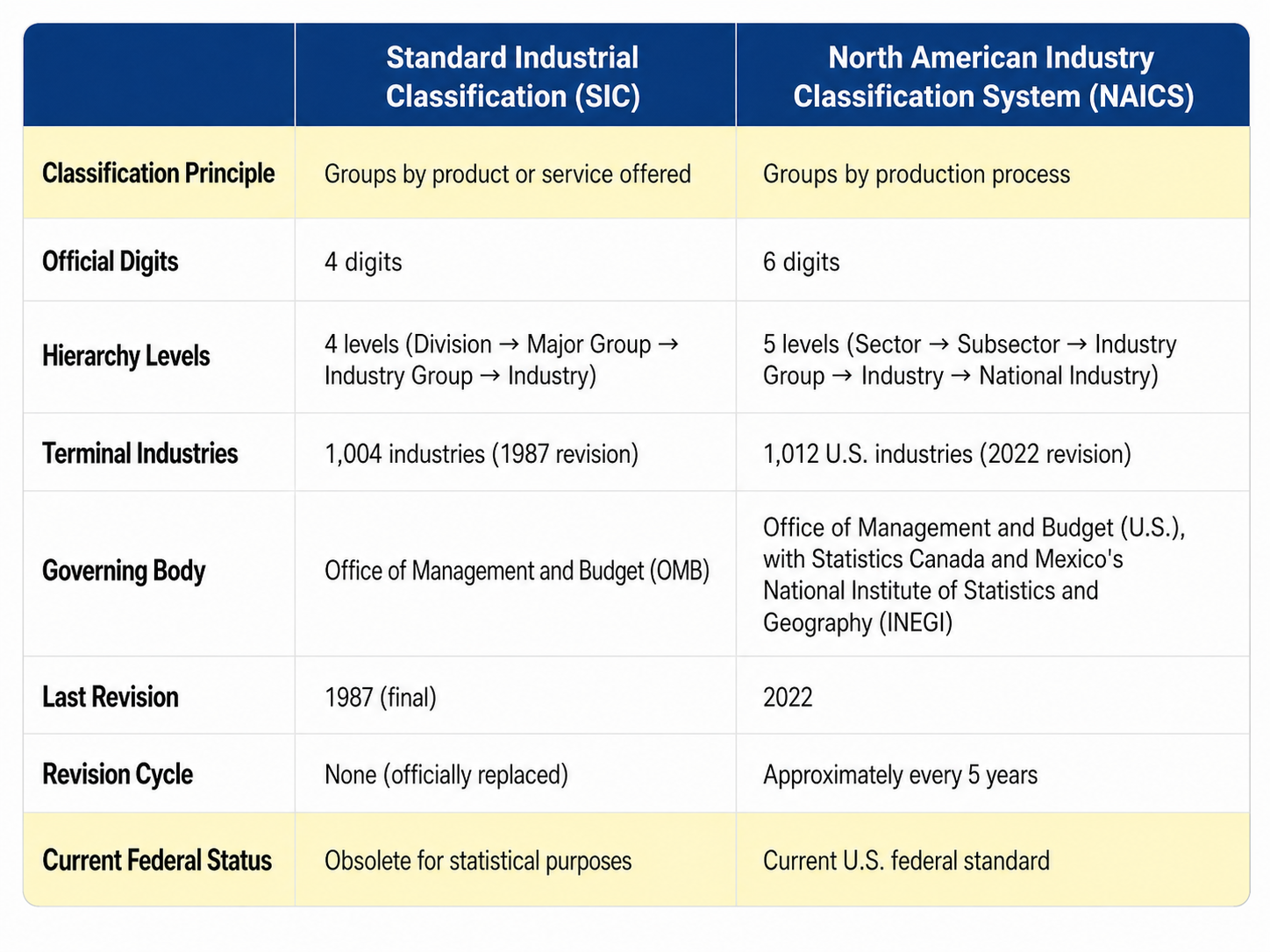
| Feature | Standard Industrial Classification (SIC) | North American Industry Classification System (NAICS) |
|---|---|---|
| Classification Principle | Groups by product or service offered | Groups by production process |
| Official Digits | 4 digits | 6 digits |
| Hierarchy Levels | 4 levels (Division, Major Group, Industry Group, Industry) | 5 levels (Sector, Subsector, Industry Group, Industry, National Industry) |
| Terminal Industries | 1,004 industries (1987 revision) | 1,012 U.S. industries (2022 revision) |
| Governing Body | Office of Management and Budget (OMB) | Office of Management and Budget (U.S.), with Statistics Canada and Mexico’s National Institute of Statistics and Geography (INEGI) |
| Last Revision | 1987 (final) | 2022 |
| Revision Cycle | None (officially replaced) | Approximately every 5 years |
| Current Federal Status | Obsolete for statistical purposes | Current U.S. federal standard |
The clearest examples are businesses that changed sectors entirely. Newspaper publishers sat in SIC 2711 under Manufacturing, but under NAICS they moved into the Information sector because the newer system classifies them by how content is produced and delivered rather than treating the printed newspaper as the defining product. Restaurants show the same shift. SIC 5812 placed them in Retail Trade, while NAICS moved them into Accommodation and Food Services because the core activity is preparing and serving meals, not retailing a finished good. Those are not cosmetic relabelings. They show NAICS moving businesses into different economic neighborhoods based on production and delivery process, which is why a SIC-to-NAICS conversion is not just a code swap.
Where Each System Is Still Used
In 2026, NAICS remains the current federal standard, but SIC codes have not disappeared from the commercial and regulatory landscape. Sales and marketing teams will still encounter both.
NAICS is the required standard for:
- Federal Statistical Agencies: The U.S. Census Bureau uses NAICS for all economic surveys, including the comprehensive Economic Census conducted every five years.
- SBA: The SBA defines its size standards which determine a company’s eligibility for small-business government contracts by NAICS code.
- Federal Procurement: Any company registering on SAM.gov to do business with the federal government must select a primary NAICS code to identify its core business activity.
SIC codes persist in these key areas:
- SEC Filings: The SEC continues to assign SIC codes to public companies in its Electronic Data Gathering, Analysis, and Retrieval (EDGAR) database. The Division of Corporation Finance uses these codes to organize companies into industry groups for review.
- OSHA: The OSHA moved its partially exempt industry list to NAICS in 2015, but it still hosts a searchable 1987 SIC manual, and older inspection records continue to carry SIC codes.
Because of this split usage, a single business record in a data provider’s or sales intelligence platform’s database can carry both codes. A prospector targeting government contractors needs NAICS, while one analyzing SEC-regulated firms needs SIC.
Why Sales Databases Still Carry Both Code Systems
Business databases carry both SIC and NAICS codes because B2B buyers still rely on both systems for different operational needs. NAICS matters when a prospect list needs to line up with government contracting workflows, SBA size standards, or SAM.gov registration data. SIC still matters when buyers are reviewing SEC filings, working from older OSHA inspection records, or using legacy CRM systems and older vendor datasets that still store SIC as a standard field.
That demand directly shapes how providers maintain coverage. Compilers like InfoFree assign industry codes to business records using a mix of public filings, directory listings, self-reported data, and primary research. Because some of those sources provide a SIC code and others a NAICS code, carrying both systems helps keep the database commercially usable across different buying workflows.
It also shapes how records are stored and searched. A single business can have a primary and secondary code, and a database that supports both systems has to track those relationships accurately. A business with more than one line of activity can carry a secondary code in each system alongside its primary code. If a user filters only by primary code, in either system, they can miss records where the relevant activity is stored as secondary.
Finally, dual-system coverage depends on code append quality. When a provider compiles records from sources that do not include both industry fields, it has to append or derive the missing code. That process is only as reliable as the provider’s methodology. Before relying on both fields, ask whether each code was assigned directly from a source or derived from the other.
Read more: Business Lead Lists – Infofree
Where the SIC-to-NAICS Crosswalk Breaks Down
The U.S. Census Bureau publishes official concordance tables, often called a “crosswalk,” to map SIC and NAICS codes. The practical problem is that there is no direct Census Bureau crosswalk from 1987 SIC to 2022 NAICS. The official concordances take 1987 SIC to early NAICS vintages such as 1997 and 2002, and then provide separate tables between later NAICS revisions. To get from a legacy SIC code to a 2022 NAICS code, a data manager usually has to chain multiple historical tables together.
This is where a simple data pull becomes a data management problem, because every step in that chain creates another chance for an outdated code, a legacy label, or a bad mapping decision to slip through.
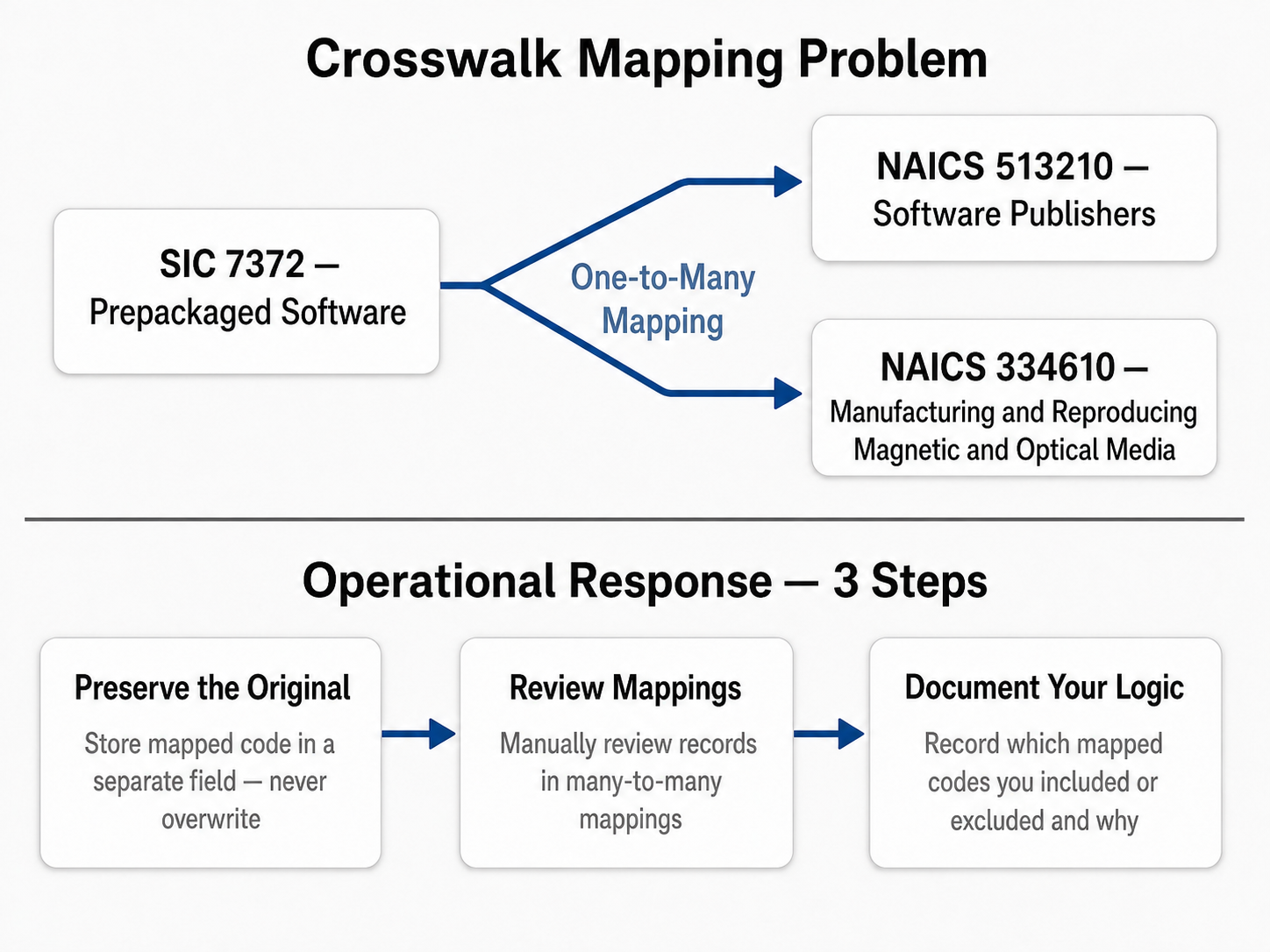
For a practitioner working from SIC 7372 (Prepackaged Software), the current 2022 NAICS endpoints to review are 513210 (Software Publishers) and 334610 (Software and Other Prerecorded Compact Disc, Tape, and Record Reproducing). That is the present-day answer. The confusion starts when a chained crosswalk carries forward an older code from an earlier NAICS vintage. NAICS 334611 is a good example. It was a valid code in an earlier revision, then was folded into 334614, and later merged into 334610 in the 2022 revision. If a team relies on chained concordances without checking the final code vintage, a retired code like 334611 can survive in a modern workflow and make the mapping look less settled than it really is.
When handling a crosswalk conversion, follow these operational practices:
- Preserve the Original: Never overwrite the original code on a record. Store the mapped code in a separate field.
- Review Mappings: Manually review records that fall into many-to-many mappings. Do not assume the crosswalk output is a perfect match for your targeting needs.
- Document Your Logic: If you choose to include or exclude certain mapped codes, document the reason for your campaign records.
How Code Selection Affects Prospect List Quality
Choosing between SIC and NAICS codes directly determines which businesses appear in your prospect list.
- NAICS 621111, Offices of Physicians (except Mental Health Specialists) is narrower than its shorthand label suggests. It covers physician practices, but it explicitly excludes mental health specialists and other establishment types that a broader legacy medical code can pull in.
- SIC 8011, Offices and Clinics of Doctors of Medicine does not map neatly to one current NAICS category. In the Census concordance, it splits across NAICS 621111 (Offices of Physicians (except Mental Health Specialists)), NAICS 621112 (Offices of Physicians, Mental Health Specialists), NAICS 621491 (HMO Medical Centers), and NAICS 621493 (Freestanding Ambulatory Surgical and Emergency Centers).
- That means a list filtered by SIC 8011 can include physician offices, mental health specialist practices, HMO medical centers, and freestanding surgical or emergency centers unless the database lets you tighten the filter at the NAICS level.
Neither list is “wrong,” but they contain a different mix of businesses. Before pulling either list, confirm which system your database uses as its primary industry tag and whether it allows filtering by both.
The same issue appears in food manufacturing. SIC 2099, Food Preparations, Not Elsewhere Classified, is a legacy manufacturing code whose crosswalk can lead to multiple NAICS categories. Depending on the product line, those mapped targets can include manufacturers of tortillas, perishable prepared foods, and sauces. A list built on SIC 2099 will not behave the same way as a list narrowed to a specific NAICS manufacturing code.
Ultimately, the quality of an industry-filtered list depends as much on the accuracy of the underlying data as it does on code selection. A record tagged with an outdated or incorrect code will appear in the wrong list pull, wasting sales time and marketing budget. This is why the data provider’s verification process deserves scrutiny.
How InfoFree Handles SIC and NAICS Code Filtering in Its Business Database
InfoFree supports both SIC and NAICS code filtering in its business database as standard firmographic fields. Users can build targeted prospect lists with either system, then narrow further by geography, employee count, annual sales volume, and executive title. For Saturation Marketing campaigns that reach every qualifying business in a defined territory, pairing either code system with a ZIP code or radius filter keeps the list limited to the vertical you intend to reach.
InfoFree compiles its business data in-house from a range of sources, and a U.S.-based research team works to verify records. Spot-check a sample of any list before a full campaign. Plans include search and view access across the database, with export limits set by the specific plan, so you can test segment combinations before exporting. Once a list is created, records can be managed in CRM101, the included CRM tool, for notes and follow-up.
As with any outreach program, customers are responsible for ensuring their calling, emailing, or direct mail campaigns comply with all applicable local, state, and federal laws, including Do Not Call (DNC) rules, the Telephone Consumer Protection Act (TCPA), the Controlling the Assault of Non-Solicited Pornography and Marketing (CAN-SPAM) Act, and state privacy laws. InfoFree is not liable for how customers use the data.
Which Code System Should You Use?
Use NAICS when your targeting needs to align with government and SBA workflows. That includes prospecting around government contracting, SAM.gov registrations, federal procurement data, and any segment where SBA size standards matter. In those cases, NAICS is the practical default because it is the current federal standard.
Use SIC when your source data, target accounts, or reference systems are already SIC-based. That includes SEC filings, older OSHA inspection records, legacy CRM fields, and older vendor datasets that still organize records around SIC. In those cases, forcing a NAICS conversion first can change the mix of businesses you pull before outreach even starts.
If your provider supports both, start with the system that matches the dataset or buying context you are actually working from. Then verify that the specific code aligns with the vertical you intend to reach, especially in categories where the SIC-to-NAICS crosswalk splits one legacy code into several current NAICS industries.
Read more: Business to Business Leads List | Infofree
Frequently Asked Questions
Does the IRS use SIC or NAICS codes for business tax filings?
The IRS uses its own six-digit Business Activity Codes, which are based on NAICS but are not identical. When filing a Schedule C or corporate return, a business selects a code from the IRS-specific list published in the form’s instructions, not a raw SIC or NAICS code.
What NAICS codes apply to coworking spaces and flexible office providers?
For coworking spaces and flexible office providers, NAICS 531120 (Lessors of Nonresidential Buildings) is the primary code because it explicitly includes renting full-service office space, whether the arrangement is structured as a lease or a service contract. NAICS 561110 (Office Administrative Services) applies in a different situation, when a provider is hired to manage the day-to-day office operations of another business rather than operating a shared workspace itself.
How often are NAICS codes revised, and what changed in 2022?
The Office of Management and Budget (OMB) revises NAICS through the Economic Classification Policy Committee approximately every five years, and the U.S. Census Bureau publishes the resulting code tables. The 2022 revision updated codes for the information and retail sectors, among others. The next major structural revision is expected in early 2027. A full list of changes from the 2017 to 2022 codes is available on the Census Bureau’s website.
Can I filter a business database by both SIC and NAICS codes at the same time?
This depends on the platform. Some business databases tag records with both codes and allow filtering by either or both fields. Others may only expose one system as a searchable filter. Before building a list, check your data provider’s documentation to see which fields are available for filtering.
What happens to my list if a company’s SIC or NAICS code is outdated or wrong?
A misclassified record will either appear in the wrong prospect list or be excluded from the right one. If a company’s primary business activity changes but its industry code is never updated, it will continue to show up in searches for its old vertical, leading to wasted outreach efforts.
Do NAICS codes matter for government contracting eligibility?
Yes, they are critical. The SBA sets its size standards the revenue or employee thresholds that determine if a company qualifies as a “small business” by NAICS code. Companies must select a primary NAICS code when registering in the SAM.gov portal to bid on federal contracts.